Monday, 26 October 2015

Freestanding Box Card

 I was recently asked for instructions on how to make this card, so I thought I would blog about it.  Even though I always keep at least one of a 'Fancy Fold' project for future reference, this did make me have to think and I had to play about with it until I fathomed it out again....old grey cells aren't what they used to be !!!!

The last time I made this card was a few years ago, around Christmas time.  I stamped and coloured a nativity scene for the card on the inside and was told by the recipients that it looked fabulous on their mantelpiece.

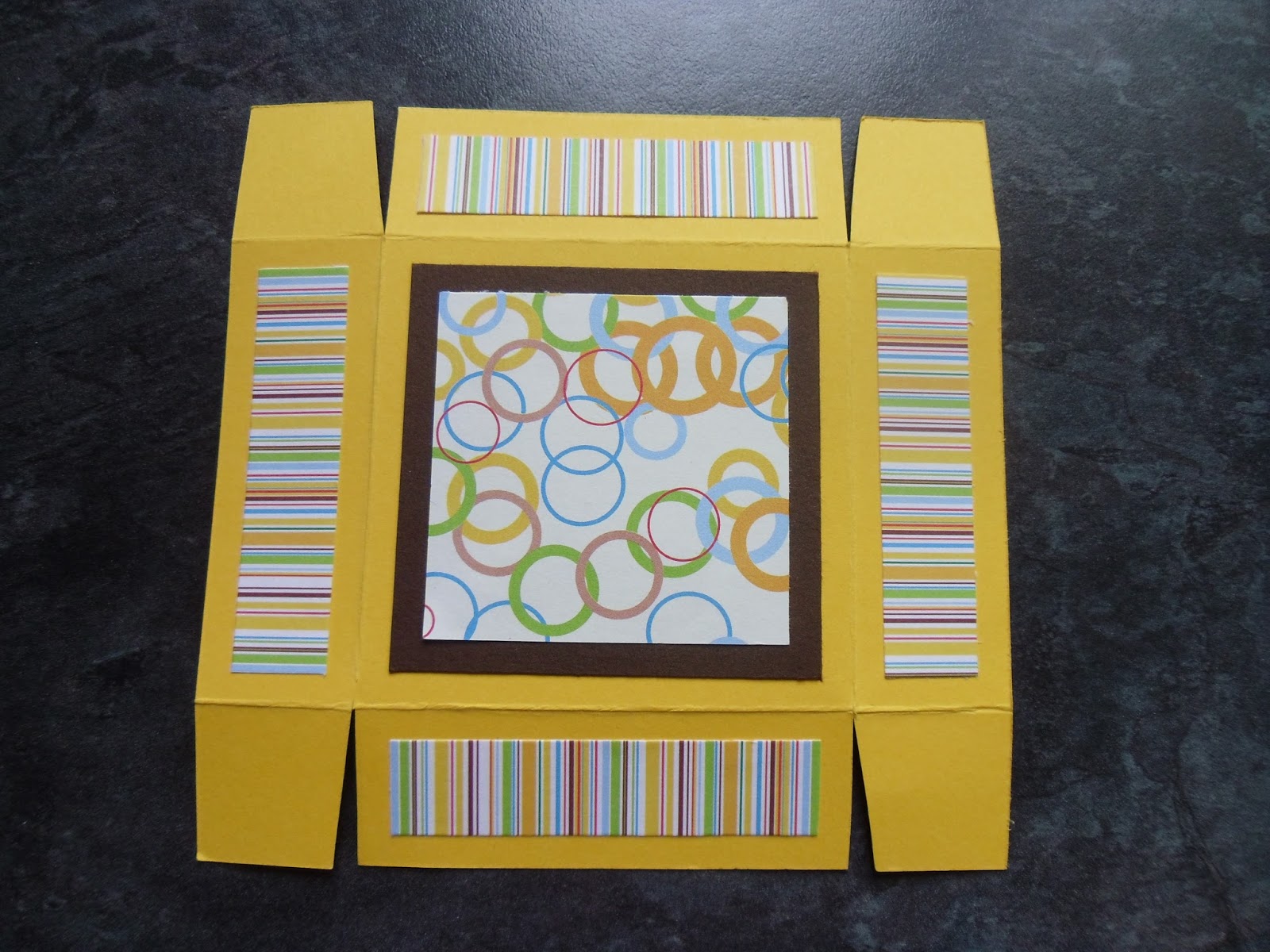
I began with a sheet of 12x12" double sided paper, because when folded you do see both sides and the inside becomes a fold back feature, so plain would not look the same.  When selecting your paper, try to choose one without a direction, or some of it may appear upside down when folded.  Smaller prints also work better on the whole. I cut mine down to 30 x 24 cms.  Save the wider strip you cut off, to make a belly and to hold it closed flat for posting.

In the landscape position, score at 3, 9, 21 & 27 cms.
In the portrait position score at 6 & 18 cms.
Looking at the first diagram, you now need to make the diagonal creases in the directions and positions marked in red.  Don't sharpen your creases just yet.

When you have scored all your lines, in a landscape position, fold in the sides, turn back the ends, and make sure these meet in the middle before you use a bone folder to sharpen your creases (photo on the left below)  Then fold the corners in (the diagonal score lines should help you do this - centre photo below), and re sharpen all these folds (photo on right below)


Now taking hold of the turn backs, you should be able to gently ease it apart so it becomes a free standing, open box.  With your fingers in the middle at the top and bottom of the box, push in towards the centre until it looks like the photo on the left.  Use a bone folder to sharpen all creases.
 Here's the 'for instance I had kept from before (not decorated).  You can see that the card nestles in the base, but also becomes your card focal point when free standing.  Because the base area is a 12 cms square, you will need to make this 'feature' card a fraction smaller, but don't reduce too much or it will fall out too easily.

I had put photo corners on mine out of some of the left over paper ***after the belly band has been made, ready to frame the image.  Alternatively, use a complimentary colour of plain card.
On the belly band below, I have cut a narrow strip, and reversed this on a broader strip (showing both sides of the double sided paper used)  The centre fluted circle (this can be plain or a different shape), simply covers the join, and possibly bridges a gap, depending on the thickness of the paper used.

 So....what are you waiting for????  Get cracking !!!
Christine

Monday, 19 October 2015

Exploding Box


Whilst this is a square exploding box, they can be made in a variety of shapes, and with fewer or more layers...so have a play !  
The basis of this square box is made up of 9 equal sections, but again, you might have shallower or higher sides, so experiment once you've made this one.  

Because I aren't one for wasting, I decided to make my largest layer 21 cms square, as an A4 piece of card is 21cms wide.

This was then scored into thirds - 7 cms wide sections.  The other pieces were cut into  18 cms square (scored at 6 cms), 15 cms square (scored at 5 cms) and 12 cms square (scored at 4 cms)  The four corner squares were then removed to form a cross shape.
 
I made the lid slightly larger than the base area, otherwise you will find that it squashes the sides in, especially when you have multiple layers.  So I started with a 12.5 cms square and scored at 2.5 cms and 10 cms.  This allowed a nice depth to enclose the base and sides within.  The notches were removed to create flaps ready for shaping and securing the lid.  I did however do all decorations before I made the lid up, and indeed before I fastened all the layers together.

Once you've cut all your layers you should have something like this.  They don't have to alternate in colour, this is entirely personal preference.


 And this is the lid waiting for the notches to be attached to the inside of the lid sides


All the layers are decorated (below) before attaching to each other at the base section.


Whilst I have only decorated with papers at this stage, it is ready for me to personalise when I decide on it's recipient.  These particular papers I feel would work equally as well for a male as well as a female.....so I have plenty of scope.
This is a Christmas themed one, using the classic 'Twas the night before Christmas' poem, spiralling around the layers among the embossed pictures.

And the blue one was something I made eons ago .... when peel offs were all in fashion !!!
Christine


Monday, 12 October 2015

Card in a Card


This card is made from a single sided gate fold and a smaller square card, that partially interlock.


So the main part is 6" x 9", scored at 6" to make a 6" square for the back panel, with a 3" x 6" panel at the right hand side. The smaller card is 4 1/2" x 9", scored in half to make a 4 1/2" square.  This is matted centrally on the back panel and opens as normal, with the spine at the left hand side.


 If you are covering your back panel with patterned paper, do this before attaching your smaller card.  I matted plain card to stamp verses and sentiments upon.

Then it's simply a case of decorating....have some fun !!!!    I added a couple of folded ribbons with brads to the front card, so I disguised them on the inside with a punched flower and leaves in similar colours to those of the patterned papers I had used.


And this is a finished version, although there is plenty of scope to add more if I choose.

Christine

Monday, 5 October 2015

'Friend' Mini Tag Book


I began this project with two large tags - they don't have to be a fancy die cut shapes,  rectngles with snipped triangular corners would work equally as well. (mine are approximately 12 x 8 cms)  They are joined together with a panel that is 7.5 x 30 cms, scored at 7.5, 15 & 22.5 cms, thus creating 4 x 7.5 cms square sections.  When I joined the outer sections to the insides of the tags, I came in about 1/2 cm from the edge.

 The patterned paper mats were cut to 7 cms squares, and the white sections were cut to 6 cms squares.  The verse was something I found on the internet.  I played about with it, changing the size, font and 'bold' for certain words, and printed onto copier paper until I was happy that I could cut into 6 cms squares.  The final square I have left to be able to write my own personal message on.  The white squares were also edged with a pale blue ink to draw it altogether.   The blue circles are there purely to cover the holes that the die made when cut.  I could have added ribbon as an alternative.

The front cover was a mixture of stamping, punching and die cuts to create a bit of a collage.  And to tie all this together, I added a dictionary quote to complete.
Christine

Monday, 28 September 2015

Circular Hanging Cascade


 For this mini project, a die cutting machine comes in really handy, and of course different sized circular dies - plain and/or fluted circles.  If you are cutting from patterned card there is no need to cut so many layers, but as I was cutting from paper, I had to reinforce the shapes with card.  

You are aiming for three sections, the central and upper ones are the same size, but I have added a smaller circular mat to the smaller one.


 If you are stamping any designs, as I have done in the completed example to the left,  do all of this before you join them together.  To join, layer the circles on top of each other, to ensure they lay centrally when stacked.  *** Please note, if you have stamped a design on your centre section, or have a directional paper, this must fall completely upside down in this stacked position, otherwise it will be the wrong way up when it is fully opened.  When you are happy with the positions, piece a hole between the  lower and central sections, and join with a brad, and another hole between the central and upper sections, and join with a brad (see photo to the left).  I also added a loop of ribbon with a third brad so it could be hung up.

As you can see, I used inks and stamps to pattern some of my sections.  You could add photographs.  What about an 18th birthday, with one picture from when the recipient was a baby, another when they were perhaps 8 or 9 years old, and then a current photo.  There are endless possibilities for this project.

To open or close, simply rotate the sections.
Christine


Monday, 21 September 2015

Male Monochrome

 Whilst I have labelled this quick and easy card 'Male Monochrome' .... yes I know....very inventive...NOT !!!! ha ha....It's a pretty straight forward design that could easily be made for any occasion (what about getting ahead with Christmas cards ?) in any choice of papers and colours, and for all age groups.


I began with an A4 sheet of card, scored in half and trimmed to approximately 14.75 cms., or there abouts.  You just need it to look square as the rest of your work will be on mats and will be exact measurements.  I then cut a main square mat (metallic card) 5 5/8", on which to lay out the rest of my mats.  The black mats were  cut to 5 1/2" x 1 3/4" (x 3 panels), and the patterned panels were cut to 5 3/8" x 1 5/8" (x 3).  This allows a reduction of 1/16" of the mats and also 1/16" between the panels and the outer edges of the main mat, thus creating a balance.  I embellished the corners of the 3 panels with some card candi and cut two shaped mats for my focal point and to draw the card all together.  Sticking with the gold accent, I decided to edge my central mat with a chisel edged metallic marker.  It's only subtle, but I felt it added something.  Alternatively you could edge with an ink - neat or sponged on softly.

As this was a male themed card, and not all males like elaborate designs, fancy florals or cute pictures, I decided to keep it simple and stamp a quote on the panel.  A very simple but effective card, I'm sure you'll agree.  So what are you waiting for? ......Don't forget to email me some of your creations
Christine


Monday, 14 September 2015

Designer Keepsake

Well I have lots of photos to share with you  this week.  This is not one of my designs, and therefore I cannot share the patterns, but hopefully the photographs will give you an idea of the mechanics of the project, and you will be able to create something along similar lines.  It's great fun, it allows our inner designer diva to emerge, and it is well received...and treasured...by the lucky recipient.


This first appeared in Creative Card Making magazine, I guess about 9 years ago, by the fabulous, inspiring designer called Carol Kaczor.  In her published handbag, she also incorporated an open box/pouch section in the base, which she had filled with lots of goodies.  Her's was also Christmas themed.  

I immediately had to make one !!!  I will show you my original a little later.  For this particular bag I used the fabulous First Edition Noir et Chic papers.  As these are 'monochrome' of black and ivory, any accent colour can just set them off - so I chose a gorgeous pink, very girly.

The main handbag sections are from three double sided papers, graduated down in size.  There are also two pockets, two handles, a flap and a tuck tab, plus two side gussets to hold it all together.  You will also need 4 large brads (these are for the feet...you know like 'posh bags have - sorry not photographed these), 2 mini brads, 4 eyelets, and a chain and charm or something to dangle.  You could add extra things into the front pockets too.  You will notice that the side gussets have some self adhesive hook and loop attached, to close it and hold it in shape.  As the handles are attached using eyelets, you will need to consider what you will put inside to cover the back of these...same with the mini brads (the 4 in the base are added before you join the middle 'bag' shape to the large one).  Do also remember to slot your chain on the front handle before you set the eyelets, unless it is one you can re open.  I found an old key chain, but I have used curtain rings and old bits of jewellery in the past.
Here is a close up of the dangling charm.  Whilst I have only used three graduating layers for the bag, as the original was, there is nothing to stop you having more.  Although, you may have to be quite a poet if you have more space to fill.  I made one about 5 years ago for a 21st and wrote a poem about this particular person and thier place in our family.  I made sure I could divide the poem down into 10 sections, printing each one and cutting and inking mats, so that when each section (page) was
turned, the poem flowed.  You could leave the last section for you to write your message, or alternatively, add a tag to the pocket.

The one to the right was the very first one I made for my mum for Mother's day - still stored safely and treasured by her...nine years later !!!

I appear to have filled it with quotes about Mother's and punched flowers, gems & card candi.
The dangly was a curtain ring with a novelty from some Easter chooclate, if I remember correctly.  We crafters are very frugal :)

I am ashamed, although they were probably the 'in thing' all that time ago, but I also included wooden bees and dragon flies hovering over the punched flowers.  My, how times and fashions change.


Above all, have fun...it is quite therapeutic as well as exciting designing a handbag.


It is sure to please that special person, worthy of such a memorable keepsake.

Christine